Thursday, October 20, 2011

A Mighty Sandwich

The sandwich is a hell of a culinary vehicle, one that should not be underestimated; though quite often, it is. Invented by the Earl of Sandwich in the mid-eighteenth century, supposedly out of the necessity to eat without having to stop gambling, it is as potentially delicious as it is convenient. Its iterations are limited only by the chef's imagination, and I have enjoyed some doozies; take Waterbar's Softshell Crab "BLT," for instance, put together with pancetta, heirloom tomatoes, crisp Bibb lettuce, and spicy aioli on thick-cut brioche. The thing is so deviously yummy, crispy and crisp and juicy and fresh; and when you're chewing a bite with everything in it, the flavor profile is totally awesome.
But sometimes a sandwich isn't intended to be a culinary work of art. Sometimes you make a sandwich simply because you have some fresh bread and some good meat and the two just go together. Such were the circumstances within which I found myself the other day.
I had a fresh baguette and a flawlessly cooked New York Strip. Even if I had nothing but these two ingredients, I would be in good shape, but I had worked an event the night before where we'd made a thick, creamy, blue cheese dressing, and I'd brought it home knowing I could put it to good use. It was the perfect spread for the sandwich. I slathered a thick layer on both pieces of bread, then toasted them in the oven at 350, finishing on broil for a minute or 2 to get some nice golden color.
And what's a steak sandwich without onions, right? I sliced one into rings and caramelized them nice and slow with some oil and a touch of butter... oh, and some of the fat I trimmed off the steak, cut up into juicy, little morsels and nestled in among the onions, releasing flavor all over the pan. You can't imitate that real beef flavor; there's nothing like it, and it is the tits. I got the pan nice and brown, then deglazed every last bit of goodness with some red wine, letting it all reduce to French Onion Soup-style richness. I was ready to build.
The steak was sliced thin, heated up gently, and sat like ribbons atop a bed of bubbly, pungent Gorgonzola, just barely tinted blue, that melted down the sides of the baguette and ran together with the pink juices of the steak to create gentle, aromatic pools on the white plate.
Sexy.
I piled the onions high atop the other piece of gorgonzola bread and sprinkled them with a handful of fresh rosemary leaves from the garden. Then, taking care to keep the ingredients on their respective buns, pressed the two halves together gently, slowly applying pressure and watching for the moment when the fillings just began to poke out the sides. I let the whole thing sit for a moment so that everybody at the party could get to know one another.
Then I took that thing down. The tangy gorgonzola spread brought a punch; the onions were sweet, smooth, and rich; the steak was juicy, succulent, and flavorful. Each part depended on the others for balance and they complemented one another exquisitely. Every bite I took brought me to pause and appreciate the perfection and exceptional deliciousness that I was holding.
And thus, the beauty of a sandwich: a pretty, little package that can be packed with so much show-stopping flavor that you almost can't believe it. Let us always try to make our sandwiches the very best sandwiches they can be.

Tuesday, October 11, 2011

Not that I'm saying I support KFC...

But I really like the new marketing campaign for their popcorn chicken. The whole thing is basically muckraking directed towards McDonalds (which I couldn't be happier about), and they attack the ambiguity of the chicken nuggett. "What part of the chicken is nugget?" the commercial asks. It goes on to let us know that KFC makes popcorn chicken; the latter being distinguished by the fact that it is off-the-bone breast meat as opposed to pressed, formed, nuggets. Given the fact that KFC is a massive fast-food corporation, I still don't trust their chicken; but this commercial speaks to a far bigger point in a really positive trend that is gaining ground in the way Americans eat.
Thanks to the efforts of people like Alice Waters, Anthony Bourdain, and even good, old Ermeril Lagasse, the spotlight has been shone on what real food is. People are actually starting to give a shit about what they eat for the first time in a long time. And I don't just mean people, I mean People. Like, all of them. Sure there's still a long way to go, but you can see it happening, very slowly, in commercials like this. You saw the same thing in recent Domino's commercials that surprised focus groups by suddenly revealing that they were actually at the farms where Domino's gets their tomatoes. People were shocked and delighted to find out that the pizzas they were eating had -gasp!- fresh tomatoes in the sauce. Just like people are going to be stoked to hear that the chicken they are eating is -gasp!- real chicken.
Ironic and potentially disturbing as these circumstances are, take faith in the fact that they are baby steps on the journey to America eating real again. The fact that people care about where there food comes from, even in these incredibly general terms, is a step in the right direction. As people all over the country, from Alice Waters to the high school lunch lady, continue to do their part in leading that march, maybe one day that McNugget will even cease to Mcbe...
But I'm getting dangerously close to sounding like a full-on picket-weilding idealist, and that wasn't my intention. Let me just say that it makes me happy to see the people who feed us being held accountable for how they do so, even in small and tragically ironic ways. Because for a very long time, they weren't. Which was bad.
So here's to you, KFC. Thanks for promising not to feed us fake chicken.

Cocoa-Habanero Wings


Let's be honest: there aren't many people out there who don't like chicken wings. Hot, mild, sweet, tangy, messy, crispy, spicy, juicy... whatever your preference, wings are a crowd-pleaser. I, personally, think it has at least something to do with the fact that you have to throw manners to the wind and just get in there if you really want to enjoy them. I hold that to be a somewhat universal law in food: if you have to work a little bit for it (wings, crabs, lobster claws, etc.), it just tastes better. Maybe that's why I became a cook.
So when Julia and I were grocery shopping the other day and she grabbed a pack of raw chicken wings, I got excited. Making wings, for me, is one of the easiest and funnest ways to cook. You need nothing more than a bowl, a bag, and your imagination. I go foraging through my pantry and fridge, scanning the labels excitedly and grabbing armfuls of spice-jars, cans and bottles that clink joyfully as I haul them onto the counter. Sometimes I have to rely on taste to identify an unmarked spice bag (hello, harissa spice mix) or mason jar (mmm, apricot-vanilla jam); it's all part of the fun. From there, it's just about putting shit into the bowl and tasting as you go.
Seriously.
I mean, use your head; don't start with chocolate milk and add a dash of mustard. Think about how you want your wings to taste. Sweet? Start with some jam, maybe, or even fruit juice. Want some spice? Just add something spicy. Anything spicy, in fact. Just add it in small amounts and check it carefully and slowly as you go. There are very few spices and flavors that won't work. The key is adding little amounts of an ingredient at first, then adjusting more generously as you start to taste what works. My mom always said, "You can always add more, but you can never take away." Follow that guideline and you pretty much can't go wrong.
It's a damn shame that there are people who believe that Hooters' wings are the best thing out there. Even sadder are the giant plastic bags of T.G.I.Friday's frozen wings in the supermarket troughs, flash frozen and frostbitten, covered in high-fructose corn syrup. And don't even get me started on boneless "wings." At that point you're just settling for the lowest common denominator, and you might as well get yourself a box of chicken nuggets and call it a day. Jackass.
So this is what I came up with; it was a HUGE hit with a panel of wing aficionados. Full disclosure: the panel consisted of Julia and myself. That being said, the wings are sweet, earthy, and had some nice kick that sort of snuck up on us, which I loved (albeit more so than Julia). I do, however, guarantee you that they were tastier, more succulent, and kicked the crap out of most of the wings you're used to tearing through. And you can tell Hooters I said that.

If you wanna try them, put all this stuff in a big bowl:

1/4 C    canola oil
1 T    chili oil
1 T    worcestershire sauce
1 1/2 T    rice wine vinegar
2 T    jalapeno jam (this is what I used, but any jam can be subbed in; a spicy jam is, obviously, best if you want more kick.)
1 T    honey
2 t    soy sauce
2 t    habanero pepper (finely minced habanero w/ seeds works, as does jarred habanero paste from mercados.)
2 T cocoa powder
1 T garlic powder
pinch of salt

Whisk all this stuff together to a smooth texture, then toss it in a large ziplock bag with 6-12 wings and refrigerate it for up to 24 hrs.

Lay the wings on a sheet tray and bake at 350 degrees, uncovered, for an hour, basting every 15 minutes.* Then eat the hell out of them.


*After you lay the wings out to bake, pour the remaining sauce from the bag into a bowl (or small saucepot) and whisk in 1-2 T of melted butter; keep it warm and use it to baste the wings with a pastry brush every 15 minutes, or more often if you want to baby them (which is juuuuuuust fiiiiiiiiine).

Wednesday, October 5, 2011

Risotto Innovation

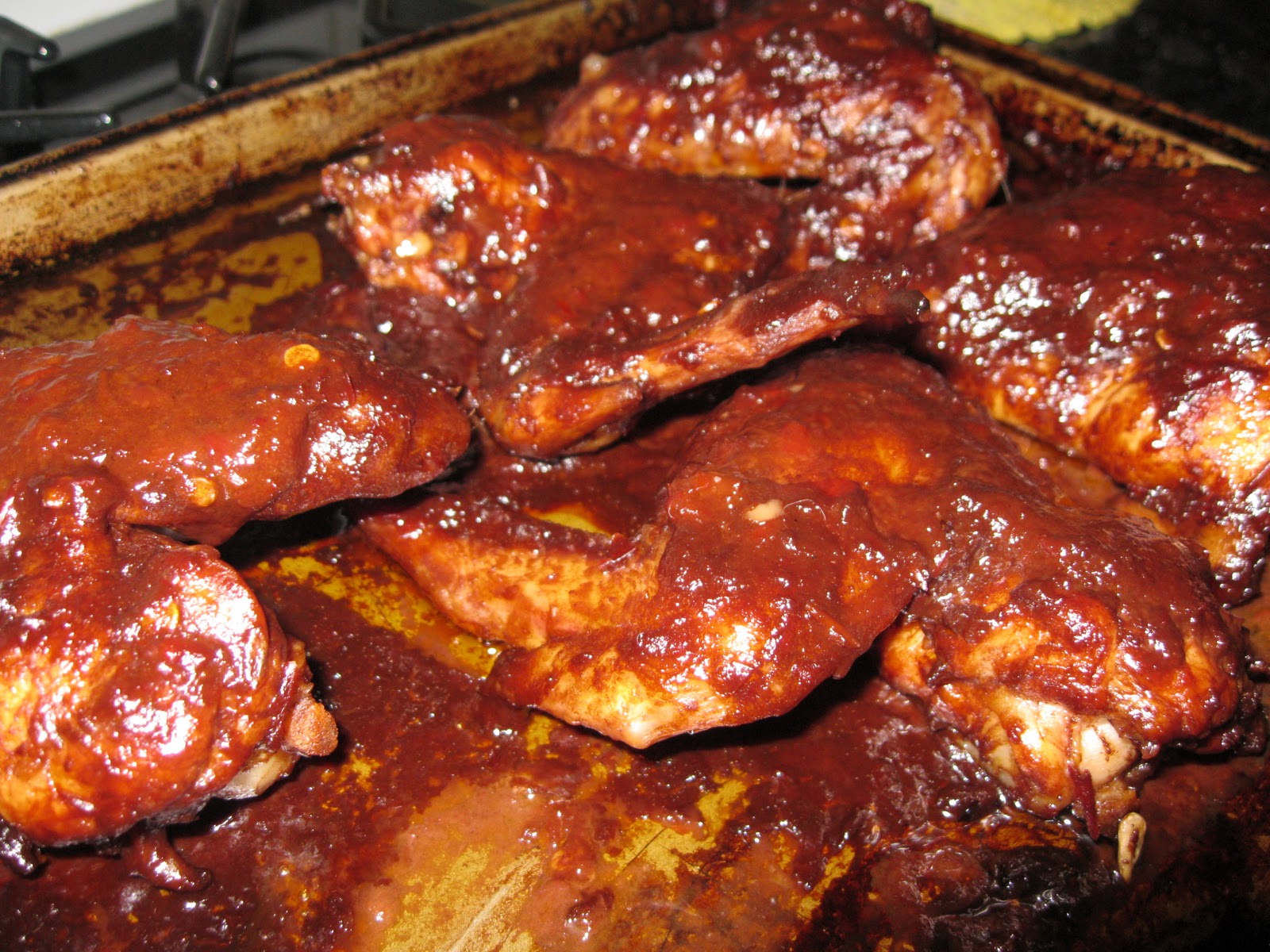
Last weekend we had dinner at Jane's house, and she made one of her specialties: Mom's Gooey Chicken. What this entails, essentially, is a chicken broken down into its eight pieces (for those who have never seen a chicken: two wings, breasts, thighs, and legs), and baked at 350 atop a generous layer of peppers, onions, and a somewhat secret recipe of seasoning and sauces. I know Worcestershire sauce plays a key role, but the rest is a bit of a mystery. At any rate, as the chicken cooks, it renders its fat and juices into the peppers, onions, and sauce, thickening like only natural animal fat can. Once everything cooks together, a few key stirs and what you have beneath (and all over) the chicken is a viscous, luscious, hearty sauce with a flavor all its own. It is called Mom's Gooey Chicken for a reason, and that reason is: it is very, very gooey. And holy moly, it is DELICIOUS.

Anyway, this is admittedly not a revolutionary way to cook chicken and it's not why I'm writing... though now that I'm here, I'm glad that Mom's Gooey Chicken is getting lauded, whatever the circumstances, because it's freaking scrumptious. No, what was new and neat and turned into gastronomic gold is what we did with the scraps.

After we polished off the chicken, we took a metal spatula and scraped all that amazing incredible goodness off the bottom of the roasting pan. I mean, seriously, we got in there and scooped up every last bit. What we ended up with was a ziplock bag of... goo. And if we're being honest, it wasn't much to look at. You know what pan scrapings look like, they're dark and sludgy and a little chunky; and I realize at this point I'm not doing a very good job of foreshadowing anything delicious, but bear with me...

I had assumed we'd end up using it for a sauce, maybe adding some booze to thin it or some flour to thicken it. We talked about making a tart out of it, or maybe just tossing some root vegetables in with a little water and making a hearty soup. Our (almost) final decision was to toss it with some pasta, something, ideally, like a rigatoni or a farfalle, whose shape and texture would best absorb and hold its ooey-gooey goodness. And then Julia took it one step further; what kind of pasta would do the absolute most absorbing? The answer was the pasta that is not a pasta at all: risotto.

We toasted the Arborio in a heavy pot for a few minutes, then added the goo and let it reduce a bit as the little grains of rice began to drink up the flavor-rich moisture. From then, we cooked it in typical risotto style; the water we used to hydrate and cook the rice had nothing more than a pinch of salt, a drizzle of oilve oil, and a parmesan rind. We stirred in some frozen peas, finished with some grated Reggiano, and dinner was served.

The flavor was even more concentrated than it had been on the chicken. At this point, the goo had been cooked down so long that it was simply bursting with hearty goodness. It was earthy, sweet, a little tangy, and had that juicy, sticky mouthfeel imparted from the chicken fat. Just so much flavor in every bite, it made me smile all the way to the last spoonful. Gotta love our new house favorite: Mom's Gooey Risotto.


*In retrospect, the one tiny thing I would have done differently is to have actually deglazed the pan, most likely with some white wine (though almost any wine would work). Also, this dish could be replicated (or improved upon) by using the scrapings from any roast dish. Ideally, you want some type of roast beast, as opposed to just a bunch of veggies, because the fat and gelatin from the meat or poultry is what will get into the goo to get it thick and velvety. However, if you must omit the meat, you could use a generous chunk of butter to help achieve the ideal texture and flavor (hell, throw the butter in even if there's meat!). Just roast your food as you normally would, and then once you pull out the main event, throw the roasting pan on a burner at high heat, wait for everything to start bubbling, then add your wine or booze (about a half a cup) to facilitate scraping the goodness off the pan. Sample booze generously.

Friday, September 30, 2011

Lunch & Tasting with Barone Ricasoli at Perbacco


Through a series of fortunate events, Julia and I recently found ourselves invited to attend a wine tasting and lunch at Perbacco. The occasion was courtesy of Barone Francesco Ricasoli, proprietor of Brolio, the oldest winery in Italy. Julia was there to photograph the luncheon and I to write about it, but let's be honest: we were there to feast on some of SF's most exceptional Italian cuisine and drink fantastic wine.

As each of the ten guests mingled into the private dining room on the second floor of Perbacco, we sipped a wonderfully tart and refreshing 2010 Albia Rose, a blend of Sangiovese and Merlot varietals. It was crisp and just a bit fruity, not that nectary-sweet picnic wine that fancy ladies drink on hot summer afternoons. An ideal palate cleanser, it was a wonderful first step in the journey upon which our taste-buds were about to embark. As we sipped our wine, Francesco chatted with us about Brolio, the 617-acre estate in Chianti that is home to the vineyards, labratories, and winemaking facilities responsible for Ricasoli's wines. He also pointed out the labels on his bottles of Colledila '07 and Casalferro '07, which featured antique drawings of the Tuscan countryside. Apparently the drawings had been found in an envelope on the Brolio estate only recently, but were drawn by an artist from Siena, depicting the landscape of Chianti, in 1584. They made excellent labels, as they were not only charming drawings but also reminders of the deep history behind Brolio's wines.

As I neared the end of my glass of Rose, the last guest arrived and Francesco invited us to sit. He sat at the middle of the table and welcomed us warmly as Brolio's Cru wines were poured in front of us: 2007 vintages of Castello di Brolio (Sangiovese with a little bit of Cab & Merlot), Colledila (100% Sangiovese), and Casalferro (100% Merlot). Each was superb, and all were quite bold in character, as expected. The cinnamon and vanilla notes were right up front, and the oak and spice warmed your tongue and tastebuds. It was wine that was easy to drink, but undoubtedly complex. Most notable was the smoothness, a particularly velvety mouthfeel somewhat surprising for a wine coming out of Chianti. We sniffed and sipped, swished and swallowed, as Francesco talked about his family's history, as well as his philosophy regarding Italian winemaking. His father had been forced to sell the winery and brand name in the early 1970s due to financial hardship, and it was purchased by spirits behemoth Seagram, who assumed that producing spirits qualified them to produce wine. After a a sufficient amount of failure in doing so, Francesco convinced them to sell the winery back to him in 1993. He did this, he says, "to get back the lost potential of this amazing estate." In control of Brolio once again, he set out to make wine.

Waiters brought in beautiful plates of fritto misto, grilled calamari, heirloom tomato with burrata, and salumi to start our meal as we listened and chatted. They poured us a 2010 Toricella Chardonnay, which complemented the seafood nicely. I found that the bright, citrus notes in the Chardonnay paired particularly well with the crispy, buttery fritto misto. Not to go unlauded, however, was the heirloom tomato and burrata plate. The tomatoes were firm but juicy, dazzlingly sweet, and striped with beautiful reds, yellows and greens. They would have stolen the show if it weren't for the pillow-soft burrata whose creamy insides ran onto the plate to collect with the tomatoes' juices for a swirling, stunning pool of pink & pale yellow that you just wanted to dive into.

In 2005, Francesco began experimenting, collaborating with different scientific institutions and universities, such as the Siena Ente Vini (Wine Authority). It was the first example in Italian winemaking where there were to be extensive, scientific studies in viniculture and viticulture. Francesco and his team at Brolio looked at every aspect of grapevine cultivation, growth, and harvest, constantly searching for the "why" behind the myriad circumstances of wine-making. They felt that though there was much to be learned about Chianti and its potential for great wines, it was, as of yet, not fully tapped into. That meant emphasizing Chianti, rather than a specific varietal.

"We are not producing varietal wines," Francesco explains emphatically. Rather, they produce excellent wines made from varietals that work best with the climate and topography of Brolio. Seventy percent of the soil in the vineyards at Brolio is the soil that has been there forever. By "respecting the soil," as Francesco puts it, he is able to let the land 'do its thing,' so to speak. This is what terroir, everyone's favorite buzz word, is all about, and it was beautifully exemplified by the Casalferro. As Francesco put it, the Merlot had been "Chianti-fied." The terroir essentially outmuscled the typical varietal characteristics of the grape to the point that the Merlot didn't actually taste much like Merlot. There was a slight and pleasant mustiness in the bouquet and far less fruit in the palate than what one would expect; in all, surprising but really nice.

The next course laid before us was a duet of agnolotti: small pillows of roasted veal and Savoy cabbage with a luscious sugo, and large, plump discs of braised rabbit complemented by small, bronze-hued chanterelle mushrooms and a rich Moscato jus. The most striking aspect of the dish, by far, was the brilliant golden tint of the pastas, making it clear to any cook that the chef had used only the best eggs in his preparation. The flavor and texture of the dough only reinforced this as we chewed contently and savored every mouthful. Brolio's 2008 Chianti Classico and 2008 Chianti Classico Riserva Rocca Guicciarda found their way into our glasses as we ate. The dark fruit notes and intense aroma stood up to the bold meatiness of each pasta, but the balance in the wines did well to share the spotlight with the more delicate veal. It was exquisite pasta paired with exquisite wine; what more could I ask for in life?

There was undoubtedly an overarching theme throughout Francesco's thoughts and musings on wine and wine-making: the idea of reaching a harmony between the grapes and the land so that when it comes to human intervention, the winemakers at Brolio have to do as little as possible. "The wine is not working for me," he smiles. "I am working for the wine." He relates being described as a "modernist" due to his scientific methods in wine-making, but Francesco doesn't see it that way. He is simply trying to make exceptional wine by whatever means work best. Currently, he is working on capturing the DNA of ancient Sangiovese vines in order to get his own grapes as close as possible to their ancestors. Brolio is using modern scientific knowledge to, in a sense, go back in history. To be growing centuries-old vines in their natural habitat of Chianti, but with the viticultural knowledge of today, yields luscious possibilities for some very, very delicious wine.

Our main course was a pan-seared hanger steak with an heirloom tomato panzanella salad. While others may have found fault in serving heirloom tomatoes twice in one meal, I could not have been more excited to see these sun-soaked beauties on my plate again. My steak was cooked to a spot-on medium rare and sliced to show this off, its juices escaping onto the plate much like the attempts of my own drool as I stared excitedly at the spectacle. I enjoyed the heirlooms no less this time around, and every forkful of beef and tomato threw a party in my mouth that made my eyes close gently and my lips stretch into a grin. With this course, we enjoyed four vintages of Brolio's Chianti Classico: 2001, 2003, 2005, and 2006. Francesco took the time to point out the difference in each vintage, allowing us to form our own opinions but giving his own as well. Though he claimed that the 2003 was one of their worst, I must admit that, taking a sip after a bite of my steak, I had no complaints. My favorite was the 2005, particularly due to the contrast between its up-front smoothness and heavy tannin. It was not abrasive in any way, yet still grabbed my tastebuds aggressively as I swished and swallowed. It is not as highly acclaimed as the '06 or the '01, but perhaps its partnership with the steak is what won me over.

When I asked Francesco if there were any new or exciting projects on the horizon for him or the winery, he shook his head with a smile. While they will continue to study and evolve their methods in order to constantly make their wines better, there is nothing that will steal their focus. In his own words, Francesco is doing his best to"track down the tradition of tomorrow" in winemaking. With science and history working hand in hand, it would appear that he is on the right track.

Sunday, September 25, 2011

Eat With Your Eyes

If anyone is actually checking in on this site, feel free to also waste your time drooling over amateur food photography on my brand new photo blog, Eat With Your Eyes. It's just a way for me to keep my best food photos in one place as I try to break deeper (read: at all) into the legitimate world of food journalism, or somewhere thereabouts.

Anyway, the photos aren't horrible, so seriously, check it out.

Monday, September 19, 2011

What the Hell is a Finger Lime?

Hours ago, I was asking myself the same question.

Up to my elbows in roast pork and sweet plantains, I was having lunch with a friend in the Food/Publishing world. As is often the case, I asked her if she had noticed any fun new trends about to swell in the local culinary scene, and Finger Limes were her almost immediate answer. I was intrigued because, frankly, I had never heard of such a thing.

Apparently it is a micro-citrus, so it is not a varietal of lemon or lime; it is shaped somewhat like a finger, which I imagine is where the name comes from; and the pulp inside is made up of individual, spherical juice vesicles that can be green, pink, or red and look like caviar.

Obviously there are a number of fun ways that you can use something like this. Chefs are always looking to make food look like other food, and 'caviar,' when able to be pulled off, never fails to impress. Add to that the fact that this fruit does have a lemon-lime flavor, which is pretty much one of the most versatile flavors in a cook's arsenal (and such acidity is the very counterpoint to saltiness when creating balance in a dish), and the finger lime becomes a pretty versatile and valuable fruit to have lying around.

Also worth noting is the fact that this fruit has only been cultivated in the last 30 years! It was discovered growing wild in Australia by aborigines, and the first tree in the United States was donated to UC Riverside; however, there has been limited success in cultivating it elsewhere, so for now it's still hard to get... which is another prized quality in the restaurant world.

So now I know what a finger lime is. And I want to eat one.

Tuesday, April 26, 2011

Terroir at its best...

Oakville Winery, 2008 Zinfandel from Oakville, CA in Napa Valley.

When one thinks Zin, one thinks fruit-forward, jammalicious, reds and blacks from the vine that sugarplum in your mouth; no tannin, smooth and sweet as summer strawberries, right? It can be a little shallow, sure, but the good ones have enough fruit in the basket to be still round and full-bodied. But while the best, or at least the most exemplary of the varietal, can be found (at least in my opinion) in Lodi or Sonoma, this one from Napa was a beautiful illustration of how the land can shape the grape can shape the wine.

So much earth and tobacco, spice, and even cinnamon on the palate, right up front and deep into your swallow. In the most simple terms, it was like a perfect Zin made passionate love to a burly Napa Cab in a dimly lit bar with a soulful man playing saxophone in the background.

I really like the idea of exploring terroir in everything. No seriously, everything...
Oysters.
Tomatoes.
Cheese.
Lamb.
Zucchini.
Eggs.
Salami.
Orange Juice.

Wine really opened the door for the world in this sense. The concept of terroir has always been there (ask French winemakers from centuries past), but until now, only educated gourmands or those who produced food at its most integral levels knew of it. Most people are accustomed to receiving a processed version of an amalgamation of similar food products. Your Mott's apple sauce, for example, probably contains apples from any number of states, or even countries. In this kind of 'food,' the terroir has been diluted and essentially lost, leaving consumers unaware of how the where of a food can hugely influence how it tastes, for better or for worse.

But with the average eater's renewed interest in where their food comes from, and eating it in the fewest steps from its source, terroir can have some light shed on it for what seems like the first time. Because even back when people knew about terroir, few acknowledged it; there was no need: it was the food it was, you ate it to stay alive and healthy, and it was great when it was delicious. End of story.

So the next time you take a bite of any whole food (or a sip of wine, which, for a beginner, probably has the most potential for such an exercise), keep your antennae up and you are likely to recognize flavors and notes in whatever you're chewing or swallowing, notes that would appear unrelated to the food itself. The more you pay attention, the more you'll taste; and the more you taste, the more you'll want to pay attention.

Sunday, April 24, 2011

The Essence of Soul

There is a place you can go; this place has taken the human soul and gently, lovingly carved out an almost quenelle-perfect scoop, prepared it with essentially flawless technique, and served its delicate essence on a plate so delectable it causes your tongue and tatste-buds to blush deviously.

Piqued?

Our greeting was cornbread, so plush and ethereal that the mere touch of our fingers caused its delicate, mealy, soft-as-are-you-kidding-me texture to crumble. Fingerfuls plunged heedlessly into our mouths, the golden sugar melted in sweet, fluffy morsels as we chewed. Honey butter? A creamy affirmative. Sweet jalapeno jam? Unfreakingdoubtedly. It's like the place said hello by delicately licking your lower lip and then moving its hands onto your

We ordered a few small plates in coursings, and the first act was- god-DAMN -the Country Fish Fry. Cornmeal fried oysters, calimari, & catfish with seasonal veg and some surprise prawns. Okay, we've all had fried seafood platters. Whether it's fish & chips, fritto misto, or fried scrimps at Red Lobster, if you can get it golden brown and crispy, you live to fry another day. It's not hard to make fried food taste delicious because it's (wait for it...) fried!
But we ate fried ocean treats so crispy that for the time elapsed as we ate, I did not hear a word of our conversation; I smiled intermittently and nodded when it seemed appropriate, but inside my head I was thinking: mmm, this is so -crunch- freaking -crispcrunch- that I -cracklecrunchcrunch- in my -crisp- mmm, calimari sex -crunchcrisp... you get the idea. There were fried baby asparagus, shaved lemon wheels, and baby artichoke so succulent it was like a tiny soup exploded into your mouth when you sank your teeth into its sexytime flesh. A soup made entirely of lemony orgasm. Too far? Okay then moving on...

I was drinking a medium bodied California Riesling because it paired nicely with the aforementioned, corn-meal crusted Pacific orgy (sorry, I just get excited), as well as course two: Little Gem Salad with Buttermilk Dressing, Molasses-Candied Pecans, & Cornbread Croutons. When the (warning: pun overload) sweet little gem of a salad arrived at the table, its simplicity is what struck a first impression with me. Everything in the menu description was upstage on the plate, and nothing else. And, cue digression...

I absolutely love the idea of this kind of simplicity, a primary tenet of Slow Food and everything that makes California food California Food. Take a few (as in literally, no more than three or four) ingredients, give each one some real love, and let them work together to show just how much greater then the sum of its parts the whole can be. This California Soul Food is done with style and elegance and it's so delicious you'd punch your grandmother....

But I digress. By course three I was onto a Tempranillo, ready to stand up to Bourbon Glazed Pork Belly with Celery Root-Parsnip Puree. Having it arrive to our table made me feel a kind of the way I imagine standing naked with Megan Fox would: A little weak-kneed, confused, marginally intimidated, giddy, sweaty, probably drooling a little... you get the picture. Pork belly is one of those products that tends to get used almost like truffle or blood diamonds: in essence, a little goes a long way. But this mammoth beast of decadent pork flesh sat before us like an architectural masterpiece, tall and wide and breathtaking in its layers of flavor-rich, succulent texture. It sat in the puree defiantly, claiming its deserved attention and relegating the (albeit delicious) puree to an afterthought forced to bow in the presence of awe-inspiring, thick-cut Belly.

By the way, once again: everything on the plate was in the menu description. It was just perfect pork belly and perfect puree. Simple but exquisite.

And now, the main event. Enter a big ol' glass of Napa Cab to pair with the Full Rack of Dry-Rub Babyback Ribs with NC-Style Barbeque Sauce and White Truffle Mac & Cheese. The ribs were crispy and spicy on the outside but fell apart with ease the second your lips and teeth pushed the moist, tender meat from the bones.

The vinegary sauce caught you off guard with her vinegar-acid tang if you didn't pay her proper attention, but rewarded you with velvet sugar if you kissed her softly handled her gently. Mmm, sweet and sharp in your throat, it made you catch your breath momentarily if you weren't ready for it. Such big flavor from such little punches!

And the mac & cheese was exactly as good as you'd expect sharp cheddar, al dente elbow macaroni, and white truffle oil to be. Just think about it. Hompadees.

Okay, so we really shouldn't have eaten any more. But I don't not order dessert. It's just not something I do. So we did. And holy shit, can you believe it? It was kind of the best part of the meal. Perfect, and I mean fucking PERFECT beignets. I have had the real deal in New Orleans; I've had four-star chefs' versions thereof; these killed it like OJ, without a doubt. Puffed up like long balloons at a child's birthday party ready to become giraffes, crusty, warm dough shells saturated with powdered sugar, thin line of dark chocolate ganache striped down the inside.
There was decadent ganache to dip, and, no bullshit, carbonated espresso, foamed, with a touch of sugar. For dipping. Totally unexpected and unique. So it was like a little shot glass with a centimeter of espresso on the bottom and the rest of the glass full of sweet espresso essence captured in what looked like the head of a beautiful IPA. You dipped as you ate and it saturated the dough like the two were made to fornicate, and then when you were done with your beignets, you drank the little sip of coffee at the bottom.

Am I shitting you, or is that not as literally perfect an end to a meal as one can hope to achieve?

Okay, get your mind out of the gutter.

At any rate, I was beyond impressed by the meal; I was inspired. And better yet, nearly everything else on the menu, as in the dishes I didn't have sex with (yet), looked equally as dope. See you soon, Cali-Soul Food... Call me!

Saturday, April 16, 2011

Just a really good burger...

Toasted Acme ciabatta (melted smoked Gouda)

Rough-chop mesclun greens

Crispy thick-cut bacon (orange/fennel/spice)

Honey-caramelized onions/reduced caramelized onion jus

All-beef burger (rosemary/greek oregano/wild garlic)

Aioli (whole grain mustard/bacon fat/black truffle)


freakin' delicious.